Babu Umair | Global Marketing Leader

Nullam dignissim, ante scelerisque the is euismod fermentum odio sem semper the is erat, a feugiat leo urna eget eros. Duis Aenean a imperdiet risus.

SEO Isn’t Dead: It’s Becoming AI Visibility — What Marketers Need to Understand About Search in 2026

By Babu Muhammad Umair | Digital Marketing Specialist | Content & Social Media Strategist
Search is changing faster than ever, and AI visibility is becoming increasingly important for marketers. As a result, brands need to think beyond traditional rankings and focus on how their content appears across AI-powered search experiences.
From my own digital marketing experience, I have learned that visibility depends on more than simply publishing content. Instead, it requires strong research, useful information, creative storytelling, and a clear understanding of the audience.
What Is AI Visibility?
AI visibility is the ability of a brand, website, or piece of content to appear in AI-generated answers and recommendations.
Traditional SEO focuses heavily on helping search engines understand and rank webpages. However AI search adds another layer. Platforms can analyse information from multiple sources and use it to generate an answer for the user.
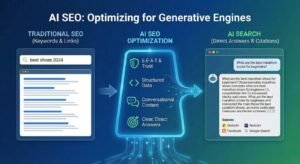
As a result, a potential customer might discover your brand without ever clicking the traditional blue link.
More importantly, that changes the marketing game.
In my own work, I have always looked beyond one metric. When managing campaigns, I consider reach, engagement, audience behaviour, content quality, and conversion together. Similarly, AI search requires a similar mindset.
Instead your goal should not simply be:
“How do I rank #1?”
Instead, ask:
“How can I become one of the most useful and trusted sources for this topic?”
That is the foundation of modern AI visibility.
Why Traditional SEO Alone Is No Longer Enough
SEO is still extremely important. Technical optimisation, keyword research, internal linking, backlinks, useful content, and website structure continue to matter.
However, search behaviour is becoming more conversational.
- Someone searching for a digital marketing agency might type:
“best digital marketing agencies”
- But with AI search, the same person might ask:
“Which digital marketing agency would be best for a small technology company that wants to grow through social media?”
The second question requires deeper context.
For this reason, this is something I experienced while working on campaigns. A keyword by itself never tells the complete story. I have often looked at the audience behind the keyword: their interests, behaviour, platform preferences, and reasons for taking action.
That approach becomes even more valuable when creating content for AI-powered search.
Ultimately, instead of producing an article simply because a keyword has search volume, marketers need to build content around real questions, genuine problems, and useful answers.
From Keywords to Questions, Topics, and Entities
One of the biggest changes I see in modern search is the move from individual keywords toward broader topics.
For example, instead of creating five separate articles around:
- AI SEO
- AI search
- ChatGPT SEO
- GEO optimisation
- AEO optimisation
For example,a stronger strategy can build one authoritative content ecosystem covering how AI is changing search, how businesses can adapt, and how different optimisation approaches work together.
In the same way, search strategy should focus on the bigger picture.
When I worked with audiences around drone racing, I did not think about one isolated message. I looked at the bigger audience journey: Who are they? What interests them? Which platform do they use? What type of content catches their attention? What makes them return?
Search strategy should work in the same way.
As a result, the stronger your topical authority becomes, the easier it is for both humans and AI systems to understand what your brand knows.
My DCL Experience: What 75 Million Viewers Taught Me

One of the most valuable lessons in my career came from working around Drone Champions League (DCL) campaigns.
At one point, I faced a campaign challenge where the target was 50 million unique viewers from a limited number of cities around a two-day event. At first, the target looked ambitious.
However, instead of simply launching advertisements, I went deep into research.
First, I studied audience behaviour, campaign opportunities, platforms, targeting options, and previous case studies. Then, I tested different approaches and continuously adjusted the strategy.
The final result reached approximately 75 million targeted unique viewers.
More importantly,that experience taught me something that applies directly to search in 2026.
Visibility comes from relevance.
We did not reach that audience because we shouted the same message everywhere. We reached them by understanding where the audience was, what interested them, and how the campaign could reach them effectively.
Similarly, AI search works from a similar principle.
First, AI systems need context. In addition, they need reliable information and clear signals that help them understand whether a source is relevant and trustworthy.
So when I think about AI visibility, I don’t see it as a completely new marketing discipline. I see it as another evolution of what good digital marketers have already been doing: understanding audiences and creating valuable experiences.
GEO, AEO and LLM Optimisation: What Do They Actually Mean?
You may have seen several new terms appearing in digital marketing discussions.
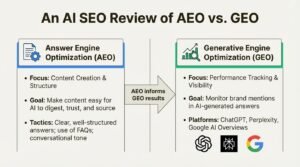
Generative Engine Optimisation (GEO)
In practice, GEO focuses on improving the chances of your content being surfaced or referenced by generative AI search experiences.
Therefore, the emphasis is on creating clear, useful, structured, and authoritative information.
Answer Engine Optimisation (AEO)
AEO, meanwhile, focuses on providing direct answers to questions.
As a result, marketers should understand the questions their audience asks and provide concise, useful responses that search systems can easily interpret.
LLM Optimisation
LLM optimisation is a broader concept involving the way content is structured and presented so that large language models can understand the information and its context.
Importantly,these approaches overlap with traditional SEO.
However,they do not mean that marketers should throw away everything they have learned about search.
Rather, they encourage us to improve the quality and usefulness of what we already create.
Why Brand Authority Matters for AI Visibility
Imagine two websites publishing information about the same topic.
For example, One has hundreds of detailed articles, expert opinions, original research, mentions from reputable websites, and a recognised brand.
By comparison,The other publishes generic articles without demonstrating expertise.
Which one would you trust?
The answer is obvious.
Therefore, brand authority is becoming an increasingly important part of AI visibility.
Throughout my career, I have seen the same principle on social media.
A brand can publish dozens of posts, but audiences often connect more strongly with people, stories, experiences, and proof.
This is why personal branding, PR, social media, influencer marketing, and SEO should not be treated as completely separate activities.
Instead, They can strengthen each other.
First, a strong social presence can create awareness.
Meanwhile, PR can build authority, while expert content can demonstrate knowledge.
In addition, backlinks can strengthen credibility, and SEO can help people discover everything.
Ultimately, these combined signals create a much stronger digital presence.
AI Citations Are Becoming a New Marketing Opportunity
One of the most interesting developments is the role of citations and sources in AI-generated answers.
For example,when an AI system provides an answer and references sources, those citations can introduce users to websites they may never have discovered through traditional search.
For marketers, this creates a new question:
“What would make an AI system want to reference my content?”
However,the answer is not simply adding more keywords.
Instead, focus on:
- Original research
- Expert insights
- Accurate statistics
- Clear explanations
- First-hand experience
- Strong topical relevance
- Trustworthy external references
- Well-structured content
More importantly,this is where my own marketing experience influences how I approach content.
When I write about digital marketing, I do not want the article to sound like it was created from a list of generic marketing definitions. I want to include lessons from actual campaigns, experiments, successes, and mistakes.
Ultimately, that first-hand perspective makes content more useful.
How I Would Build an AI-Ready Content Strategy
If I were starting an AI-focused content strategy for a brand today, I would use a simple framework.
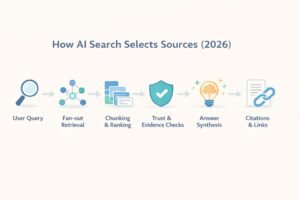
1. Understand the Audience
First, before creating content, identify what your audience actually wants.
Look at search queries, social conversations, customer questions, comments, and competitor content.
In my experience, this is something I have relied on throughout my digital marketing journey.
2. Build Topic Clusters
Rather than publishing random articles, create interconnected content around important subjects.
For example:
Main topic: AI-powered search
Supporting topics could include:
- AI search optimisation
- GEO
- AEO
- LLM optimisation
- AI citations
- SEO and AI
- Content authority
- First-party data
- Brand visibility
3. Add First-Hand Experience
This is where brands can differentiate themselves.
More importantly,Don’t just explain what something is.
Instead, Explain what happens when you tested it.
My DCL campaign experience is a good example. The numbers tell one story, but the strategy behind those numbers tells a much more valuable story.
4. Strengthen Your Authority
First, publish consistently and contribute expert opinions.
In addition, earn quality backlinks and build relationships with relevant publications.
Furthermore, create original research that demonstrates your expertise.
Ultimately, the objective is to become a recognised source within your niche.
5. Make Content Easy to Understand
First, use descriptive headings and keep paragraphs focused.
Next, answer questions directly and add relevant statistics.
For example, use practical examples to make complex ideas easier to understand.
In addition, connect related pages through internal links.
Ultimately, these practices benefit both human readers and search systems.
SEO + PR + Content + Social Media Are Becoming One System
For years, marketers have often treated SEO, PR, social media, content marketing, and branding as separate departments.
However, I think that approach is becoming outdated.
For example, consider a simple campaign.
First,you publish an original research report.
Then,a journalist discovers it and writes about it.
As a result,that article generates a backlink.
Meanwhile,your social team turns the research into short videos.
At the same time,an expert from your company discusses the findings on LinkedIn.
Eventually,other websites reference the research.
Meanwhile,people search for your brand.
AI systems encounter your information across multiple credible sources.
Suddenly, one piece of content has created multiple visibility opportunities.
Ultimately,this is the future I see developing.
And it is why modern marketers need to think like strategists, not just content producers.
What Marketers Should Stop Doing in 2026
The biggest mistake would be chasing every new AI acronym without improving the fundamentals.
For example,don’t create content simply to satisfy an algorithm.
For example, avoid publishing hundreds of low-quality AI-generated articles.
Instead, focus on creating useful content rather than stuffing the same keyword into every paragraph.
Moreover, don’t rely entirely on generic AI content; add original insights, experience, and expert perspectives.
Most importantly, don’t forget your audience while trying to impress search engines.
I have learned through campaign work that optimisation only works when it supports a real objective.
Ultimately, a beautifully optimised campaign that nobody cares about will still fail.
The same principle, therefore, applies to AI search.
What Marketers Should Start Doing
Instead, focus on creating content that is:
Useful. Answer real questions.
Original. Add experiences, data, research, or opinions.
Credible. Support important claims with reliable sources.
Structured. Make information easy to understand.
Connected. Use internal links to build topic relationships.
Human. Add stories and real experiences.
Consistent. Build authority over time.
This approach doesn’t just support AI visibility. It also creates better content for traditional search, social media, newsletters, and customers.
AI Visibility and the Future of Search
The biggest change in digital marketing is not that Google is disappearing.
Rather,It is that discovery is expanding.
People can discover brands through Google Search, AI assistants, social platforms, YouTube, Reddit, newsletters, influencers, communities, and recommendations.
As a result, marketers need to stop thinking about visibility as one ranking position.
Instead, think about the entire digital ecosystem.
First,where does your audience discover information?
Next,who influences their decisions?
Similar,which sources do they trust?
More importantly,what questions do they ask?
Finally, what information would make them choose your brand?
These are the questions I now find much more interesting than simply asking, “What keyword should we rank for?”
My Takeaway From the Race to AI Search
My experience in digital marketing and campaigns such as DCL has taught me that the strongest strategies are rarely based on one tactic.
First, you need research and creativity.
At the same time, data and experimentation are essential.
Most importantly, you need to understand people.
AI is changing how people discover information, but the fundamentals of good marketing remain surprisingly human.
The brands that win in 2026 will not necessarily be the ones producing the most content. They will be the ones producing the most useful, credible, memorable, and authoritative content.
SEO isn’t dead.
It is evolving.
And AI visibility is becoming an important part of that evolution.
For marketers like me, that makes the future even more exciting.
Final Thought
When I look back at campaigns where I had to reach millions of viewers, I realise that the same principle keeps appearing: understand the audience first, then optimise everything around them.
Whether I am working on a social campaign, influencer strategy, content plan, SEO project, or an AI-focused search strategy, that principle remains the same.
Technology can change the way people discover information, but it cannot replace the human understanding behind effective marketing.
Ultimately, AI may change the tools marketers use, but the fundamentals remain the same: understand people, create value, build trust, and keep improving.