Babu Umair | Global Marketing Leader

Nullam dignissim, ante scelerisque the is euismod fermentum odio sem semper the is erat, a feugiat leo urna eget eros. Duis Aenean a imperdiet risus.

Stop Celebrating Reach: The Measurement Question Every Marketing Leader Should Ask Instead

By Babu Muhammad Umair | Digital Marketing Specialist | Content & Social Media Strategist
For years, Marketing Measurement Strategy has often started with familiar numbers such as reach, impressions, views, clicks, and engagement. While these metrics are useful, they do not always answer the question that matters most to a marketing leader:
What did marketing actually change?
I have spent a significant part of my marketing career working with reach, views, impressions, paid media, and audience growth. Naturally, these numbers can look impressive in a campaign report. Yet, over time, I learned that a bigger number does not automatically mean a bigger business impact.
As a result, my approach to campaign performance has changed. Instead of asking only, “How many people did we reach?”, I increasingly ask:
“What happened because we reached them?”
That shift may sound simple. Nevertheless, it represents a much bigger change in how modern marketing performance should be evaluated.
Marketing Measurement Strategy:Reach Is a Starting Point, Not the Finish Line
Reach tells us how many unique people were exposed to a campaign. Similarly, impressions tell us how many times content was displayed.
Both metrics matter. However, neither one proves that the campaign caused someone to take action.
For example, imagine a campaign reaching 50 million people. On the surface, that sounds like a huge success. But what if those 50 million people would have discovered the brand anyway? What if sales, registrations, website visits, or brand consideration did not increase?
Suddenly, the reach number tells only part of the story.
Therefore, the real challenge is not simply collecting more data. Instead, it is connecting marketing activity with meaningful business outcomes.
This is where a strong Marketing Measurement Strategy becomes important. The goal is not to eliminate reach and impressions, but to connect those metrics with audience behaviour, incremental outcomes, and business performance.
From 50 Million to 75 Million: When Reach Became a Bigger Question
I experienced this first-hand while working on a campaign where our initial target was 50 million unique viewers across several cities over two days.
At first, the objective appeared straightforward: maximise reach and put the campaign in front of as many relevant people as possible.
However, we did not stop there.
We researched the audience, studied relevant case studies, developed customised campaigns, and continuously optimised our resources. As a result, the campaign eventually reached 75 million targeted unique viewers.
That was a strong result.
More importantly, the experience taught me something beyond the headline number.
The real value came from understanding why we achieved that result, which audiences responded, which channels contributed, and how our decisions influenced performance.
Consequently, reach became a measurement input rather than the final definition of success.
Why Marketing Leaders Need a Better Marketing Measurement Strategy
Every major advertising platform provides an impressive collection of metrics.
You can see impressions, reach, clicks, video views, engagement, cost per result, conversion rates, and many other numbers within minutes.
Yet, there is a problem.
Platforms are designed to report activity. Marketing leaders need to understand impact.
Those are not always the same thing.
For instance, a campaign can generate millions of impressions while producing limited incremental demand. Likewise, a channel can appear highly efficient in an attribution report while receiving credit for customers who were already likely to convert.
Therefore, the more sophisticated the marketing operation becomes, the more important the Marketing Measurement Strategy becomes.
A good framework should connect three levels:
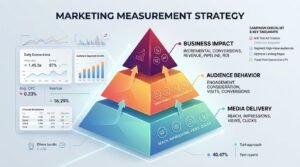
- Media delivery: reach, impressions, frequency, views, clicks and cost.
- Audience behaviour: engagement, visits, consideration and conversion behaviour.
- Business impact: incremental conversions, revenue, pipeline, customer acquisition and brand growth.
Incrementality: The Question Behind the Number

One of the most important questions in modern marketing is:
Would this result have happened without the marketing activity?
That is the heart of incrementality.
Rather than simply asking which channel received credit for a conversion, incrementality asks whether marketing actually caused additional conversions, revenue, visits, or another desired outcome.
This distinction is extremely important.
Suppose 1,000 people purchase after seeing an advertisement. Traditional reporting might attribute a portion of those purchases to the campaign.
However, an incremental approach asks a different question:
How many additional purchases happened because of the campaign?
For a marketing leader, that is a much more valuable question.
My TikTok Experience Taught Me Another Measurement Lesson
Another experience reinforced this mindset for me.
I once worked on a campaign where the objective was to drive significant traffic to a website that our team did not directly own. Because of that setup, we faced limitations around installing our own pixels and tracking infrastructure.
Instead of treating those limitations as an excuse, we looked for another way forward.
We spoke with marketing professionals across Meta, TikTok, and Google to understand what could realistically be measured. In addition, we explored how Google Tag Manager could help us work within the technical constraints.
Initially, I expected Meta, Facebook, and Instagram to be the strongest performers.
Surprisingly, TikTok outperformed expectations and delivered 60% more results than our original target.
That experience reminded me that assumptions can easily influence measurement.
If I had judged the campaign only through my initial expectations, I might have underestimated TikTok before the data had a chance to prove otherwise.
Therefore, good measurement is not about confirming what we already believe. Rather, it is about creating a framework that allows the data to challenge us.
Attribution Doesn’t Tell the Whole Story Either
Attribution is valuable. Nevertheless, it has limitations.
A customer may interact with multiple channels before converting. For example, one person might discover a brand through TikTok, watch a video on Instagram, search on Google, visit the website, and finally convert after receiving an email.

So, which channel caused the conversion?
Depending on the attribution model, the answer can change.
First-click attribution may favour the initial interaction. Meanwhile, last-click attribution may reward the final touchpoint. Platform-specific attribution can provide yet another perspective.
For that reason, attribution should be treated as one lens, not the entire Marketing Measurement Strategy.
Marketing Mix Modeling Is Making a Comeback
Another approach gaining attention is Marketing Mix Modeling (MMM).
Unlike user-level attribution, MMM looks at broader relationships between marketing investment and business outcomes. In particular, it can help organisations understand how different channels contribute to overall performance while accounting for external factors.
For larger organisations with significant marketing budgets, this can provide a valuable strategic perspective.
However, MMM is not a magic solution either.
It depends on data quality, appropriate modelling, business context, and strong interpretation. Therefore, the best measurement approach is rarely about choosing one methodology.
Instead, it is about combining different methods to create a clearer picture.
Moving From Reporting to a Marketing Measurement Strategy
There is an important difference between reporting metrics and measuring impact.
Reporting tells stakeholders what happened.
Measurement tries to explain why it happened.
That distinction has influenced the way I approach campaigns.
When I review performance, I do not want to see only a collection of impressive numbers. Instead, I want to understand the relationship between investment, audience, channels, behaviour, and outcomes.
For example, instead of saying:
“We generated 100 million impressions.”
I would rather ask:
- How many people were genuinely relevant to the campaign?
- What percentage of the audience was incremental?
- Which channels influenced behaviour?
- Did brand awareness or consideration change?
- Did website activity increase beyond the expected baseline?
- What business outcome followed the exposure?
- Could we have achieved the same result with less spend?
These questions create a much stronger marketing conversation.
The Metrics I Would Put in Front of a Marketing Leader
If I were building a senior-level marketing dashboard, I would not remove reach or impressions.
Instead, I would put them into context.
The dashboard should combine media delivery, audience behaviour, and business impact.
Some of the metrics I would consider include:
1.Reach and frequency — How many relevant people did we reach, and how often?
2.Engagement quality — Did audiences meaningfully interact with the content?
3.Incremental conversions — How many additional actions can reasonably be attributed to marketing?
4.Customer acquisition cost — How efficiently are we acquiring customers?
5.Revenue or pipeline contribution — What financial outcome is connected to the campaign?
6.Brand impact — Did awareness, consideration, preference, or recall change?
7.Channel contribution — Which channels appear to be creating genuine incremental value?
8.Marketing efficiency — Are we generating more impact from the same or lower investment?
As a result, the dashboard provides a much more balanced view of performance.
Data Is Powerful, but Context Matters
One lesson I have learned throughout my marketing career is that data does not make decisions by itself.
Context matters.
A sudden increase in website traffic could indicate successful advertising. On the other hand, it could also be caused by a news story, influencer mention, seasonal behaviour, competitor activity, or an external event.
Likewise, a drop in conversions does not automatically mean the campaign failed.
Perhaps the landing page changed. Maybe tracking broke. Alternatively, the audience mix shifted.
Therefore, marketing analytics should always be combined with human judgement.
This is something I strongly believe in:
Data should challenge our thinking, not replace it.
The New Marketing Leadership Mindset
Marketing leaders are increasingly expected to defend budgets with more than attractive dashboards.
They need to demonstrate business value.
As a result, the conversation is moving from:
“How much did we reach?”
to:
“What did marketing change?”
And eventually:
“How much of that change was caused by our investment?”
That is a much more powerful way to think about marketing.
Furthermore, it changes how marketers work with finance, leadership, product teams, and other departments. Instead of presenting marketing as a collection of channel activities, we can position it as a measurable business function.
Final Thoughts: Building a Better Marketing Measurement Strategy
Reach will always matter.
Views will matter. Impressions will matter. Clicks and engagement will matter too.
However, these numbers should be the beginning of the conversation, not the end.
My experience across digital campaigns, paid media, social platforms, audience growth, and international marketing has taught me that impressive numbers are useful only when we understand what sits behind them.
So, the next time someone celebrates a campaign because it reached millions of people, I would ask one simple question:
“What happened because of it?”
That question can take marketing reporting from a dashboard exercise to a genuine Marketing Measurement Strategy.
Ultimately, that is the kind of measurement that helps marketing leaders make better decisions, defend investment, and prove real business impact.