Babu Umair | Global Marketing Leader

Nullam dignissim, ante scelerisque the is euismod fermentum odio sem semper the is erat, a feugiat leo urna eget eros. Duis Aenean a imperdiet risus.

From Campaign Manager to AI Supervisor: What Marketing Leaders Should Still Own in the Agentic AI Era
By Babu Muhammad Umair | Digital Marketing Expert | Marketing Manager at DCL – Drone Champions League
AI is changing how marketing teams work. New AI and agentic capabilities are entering advertising and analytics platforms, allowing marketers to automate more tasks than before.
As a result,shift makes Agentic AI Marketing more than a technology trend. It raises a bigger leadership question: if AI can increasingly execute campaigns, what should marketing leaders continue to own?
For me, the answer starts with strategy. My experience across digital marketing, sports, esports, technology, and e-commerce has shown me that execution matters, but direction matters even more.
At Drone Champions League (DCL), I work across international campaigns, brand partnerships, influencer activations, and multi-platform strategies. These experiences have taught me that technology can improve execution, but people still need to decide where the campaign should go.
What Is Agentic AI Marketing?
Agentic AI Marketing refers to using AI systems that can do more than generate content or provide recommendations.
These systems can analyse information, identify opportunities, make recommendations, and increasingly take action within marketing workflows.
Meanwhile,Google is expanding AI capabilities across Ads and Analytics. These developments show how marketing platforms are moving towards more automated decision-making and execution.
For marketers, this creates a major opportunity. Therefore, of spending most of the day managing repetitive tasks, teams can focus more on strategy, creativity, and customer understanding.
Why the Campaign Manager Role Is Changing
Traditional campaign management involves many repetitive activities.
Marketers monitor performance, adjust targeting, review reports, test creative, and analyse audience behaviour.
AI can increasingly support these activities. As a result, campaign managers may spend less time operating platforms and more time supervising automated systems.
I see this as a positive shift. Throughout my career, I have always tried to connect campaign activity with meaningful outcomes.
Whether I am reviewing engagement, reach, conversions, or audience behaviour, the most important question is not only what happened.
It is also why it happened and what we should do next.
What AI Can Take Over
Today,the capabilities of AI are expanding quickly. As a result,marketing teams can already use AI to support several operational areas:
- Campaign monitoring
- Performance reporting
- Audience analysis
- Creative testing
- Data analysis
- Campaign optimisation
- Routine workflow automation
Furthermore,as these systems become more autonomous, they may handle larger parts of campaign execution.
That could give marketers more time to work on positioning, creative direction, partnerships, customer experience, and long-term growth.
However, automation should not mean removing human responsibility. In fact, that is one of the biggest principles behind my view of Agentic AI Marketing.
My DCL Experience: Why Strategy Still Matters
My experience with Drone Champions League (DCL) has made this difference very clear.
International sports and esports campaigns involve multiple audiences, markets, partners, creators, and platforms.
For example projects connected with initiatives such as the A2RL x DCL AI Grand Challenge and A2RL x DCL STEM Program in Abu Dhabi require more than platform execution.
More importantly,there are strategic decisions behind every campaign:
- Who are we trying to reach?
- What should the audience remember?
- Which platforms matter?
- What role should influencers play?
- How should the brand communicate?
- What outcome should the campaign deliver?
AI can help answer some of these questions through data.
However, leadership is still required to connect those answers with the wider brand objective.
What Marketing Leaders Should Still Own
1. Positioning
AI can generate hundreds of marketing messages. However, a marketing leader must decide which message represents the brand.
At the same time, positioning influences everything from creative direction to partnerships and audience communication.
From my experience, strong campaigns usually start with a clear idea rather than a large volume of content.
While AI can provide possibilities, leaders must ultimately choose the direction.
2. Strategic Judgment
Data is powerful, but it does not make every strategic decision.
For example, one campaign might generate strong short-term engagement while weakening long-term brand value.
On the other hand, another campaign could produce fewer clicks but create stronger relationships with an important audience.
This is where marketing experience becomes valuable.
Throughout my performance marketing work, I have learned to look beyond individual metrics. Reach, engagement, audience behaviour, and conversions need to be considered together.
For this reason, that mindset becomes even more important in Agentic AI Marketing.
3. Creative Taste
AI can now create headlines, images, videos, scripts, and campaign concepts at impressive speed.
However, producing more content does not automatically mean producing better content.
Therefore, marketing leaders still need to ask:
- Does this feel authentic?
- Does it fit the brand?
- Will the audience care?
- Is the idea memorable?
- Does the creative communicate something meaningful?
In my experience, content and influencer campaigns have taught me that relevance often matters more than volume.
As a result, AI can increase production, while humans should still own creative taste.
4. Audience and Culture
AI can analyse millions of data points.
However, understanding people requires more than statistics.
Audiences change, communities develop their own language, and creators influence conversations. Meanwhile, cultural trends can emerge unexpectedly.
From my experience, working across international sports and esports audiences has shown me how important context can be.
For example, a campaign may perform well on paper while still missing the emotional reason people connect with a brand.
Therefore, Agentic AI Marketing should always keep human audience understanding at its centre.
5. Accountability
This may be the most important responsibility of all.
For example, if an AI system makes a poor recommendation, someone must still own the decision.
Similarly, if automated targeting reaches the wrong audience, the brand cannot simply blame the algorithm.
Ultimately, marketing leaders remain responsible for the systems they approve.
Therefore, effective AI systems need:
- Clear boundaries
- Approval processes
- Human oversight
- Performance monitoring
- Brand safety checks
- Accountability for outcomes
From Campaign Manager to AI Supervisor
The marketing role is therefore moving towards something different.
Instead of spending all day operating platforms, future marketing leaders may supervise AI-powered systems.
In practice, the role could become:
Set the objective → define the guardrails → supervise AI → evaluate outcomes → make strategic decisions.
As a result, this shift requires a different skill set.
Marketing leaders will need:
- Technology awareness
- Analytical thinking
- Creative judgment
- Communication skills
- Business understanding
- Strategic decision-making
- Leadership experience
Importantly, these are areas I have developed through my work across digital marketing, performance campaigns, influencer strategy, and international events.
Building an Effective Agentic AI Marketing Strategy
When building an AI-enabled marketing function, I would start with the business objective.
First, determine whether the goal is:
- Brand awareness
- Revenue growth
- Customer acquisition
- Audience growth
- Lead generation
- Brand positioning
Once the objective is clear, AI can then support the right activities.
Next, identify repetitive tasks that can be automated.
For example:
- Reporting
- Data analysis
- Campaign monitoring
- Creative testing
- Routine optimisation
- Audience insights
At the same time, human guardrails should remain in place.
For instance, budget changes, brand messaging, customer communication, sensitive audiences, partnerships, and reputation-related decisions may require human approval.
Ultimately, that balance is central to a responsible Agentic AI Marketing Strategy.
Measure Outcomes, Not Automation
It is easy to become impressed by automation.
However, automation itself is not a marketing objective.
Instead, the real question is whether the system improves business performance.
Marketers should continue measuring:
- Reach
- Engagement
- Conversions
- Customer value
- Brand impact
- Campaign efficiency
- Business growth
From my experience, campaign performance has reinforced this principle.
Ultimately, a sophisticated campaign means little if it does not create a meaningful result for the business or audience.
The Human Advantage Is Moving Upstream
AI will continue becoming faster and more capable.
As a result, it will analyse more data and execute more marketing activities.
Consequently, human value will increasingly move towards higher-level decisions.
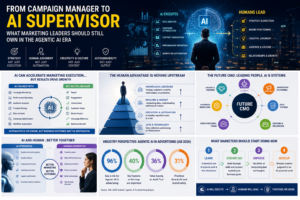
Humans will continue to own:
- Purpose
- Positioning
- Strategic judgment
- Culture
- Creativity
- Relationships
- Accountability
For this reason, I do not see AI as the end of marketing leadership.
Instead, I see it as a reason for marketing leaders to become more strategic.
Why This Matters for Future CMOs
The future CMO may manage more than people.
For example, they may oversee:
- AI agents
- Advertising platforms
- Data systems
- Creators
- Agencies
- Automated workflows
- Cross-functional teams
Therefore, this shift requires a broader leadership mindset.
A strong CMO will need to understand technology without becoming obsessed with tools.
At the same time, they must use data without losing creativity.
Similarly, automation should improve efficiency without removing accountability.
Above all, leaders will still need to protect the human side of the brand.
My own career across global campaigns, DCL, influencer activations, SEO, performance marketing, and audience engagement has shown me the value of connecting these areas.
Looking ahead, the future will require even stronger integration between them.
The Real Meaning of Agentic AI Marketing
The biggest opportunity is not allowing AI to replace every marketing task.
Rather, the opportunity is creating a better division of responsibilities.
AI can:
- Process information quickly
- Identify patterns
- Analyse performance
- Automate repetitive execution
- Support optimisation
- Generate creative variations
Meanwhile, humans can:
- Provide context
- Make difficult decisions
- Understand culture
- Protect the brand
- Build relationships
- Set strategic direction
Ultimately, this is the model I believe will make Agentic AI Marketing genuinely valuable.
What Marketers Should Start Doing Now
First, learn how AI systems actually work.
You do not need to become an AI engineer. However, you should understand what these systems can do and where their limitations exist.
Second, strengthen your strategic skills.
In particular, learn to connect marketing activity with business objectives.
Third, improve your ability to interpret data.
Tools can show you numbers, but leaders still need to understand what those numbers mean.
Finally, develop your creative judgment.
When AI can produce thousands of ideas, knowing which idea deserves attention becomes increasingly valuable.
My Takeaway as a Marketing Leader
My experience has taught me that successful marketing has never been about using the most tools.
Instead, it has always been about making better decisions.
At DCL, international campaigns require research, creativity, audience understanding, partnerships, execution, and measurement.
At the same time, AI can strengthen many of these areas.
However, it cannot replace the responsibility of deciding what the campaign should achieve and why it matters.
For that reason, I see the transition from campaign manager to AI supervisor as a leadership opportunity.
The marketer of the future will not necessarily be the person who executes everything.
Instead, they may be the person who knows what should be automated, what should remain human, and how to connect both sides to business growth.
Final Thought
The agentic AI era will change marketing jobs, workflows, advertising platforms, and the way campaigns are measured and optimised.
Nevertheless, it does not remove the need for leadership.
In fact, it makes leadership even more important.
My view is simple: AI should increasingly execute, while humans continue to own positioning, judgment, culture, creativity, relationships, and accountability.
Ultimately, that balance will define effective marketing leadership in the years ahead.
My experience across global campaigns, DCL, influencer activations, performance marketing, SEO, and international audiences has reinforced one principle:
Technology can multiply execution, but leadership determines direction.
Therefore, for marketers willing to develop both technological understanding and strategic judgment, this shift could create some of the most exciting opportunities the industry has seen.